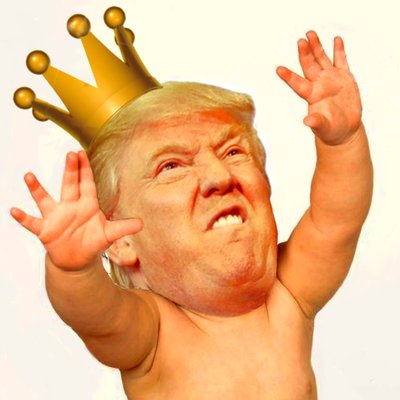
Remember SCROTUS's unscheduled visit to Walter Reed hospital last November?
Apropos of nothing*, yesterday he tweeted,
It never ends! Now they are trying to say that your favorite President, me, went to Walter Reed Medical Center, having suffered a series of mini-strokes. Never happened to THIS candidate - FAKE NEWS. Perhaps they are referring to another candidate from another Party!
The tweet left people scratching their heads. An out-of-the-blue tweet about an incident 11 months ago. No one in the news media had recently suggested that he was suffering TIAs, transient ischemic attacks (aka "mini strokes"). Shortly after this tweet, the Whitewash House physician Dr. Sean Conley released a statement at IMPOTUS's request:
"I can confirm that President Trump has not experienced nor been evaluated for a cerebrovascular accident (stroke), transient ischemic attack (mini stroke), or any acute cardiovascular emergencies, as have been incorrectly reported in the media."
Protest much?
Well, perhaps no one in the media has speculated about his multiple TIAs, but I have!
You know I've written extensively about his speech and language symptoms, pointing to a neurological condition.
Here is my blog post after that very same trip to Walter Reed. It outlines a lot of the disordered speech and language he exhibits. And it puts forth my speculation about that unscheduled trip to the hospital. I think he had a larger-than-normal TIA, went to the hospital, it cleared up, and he refused further work-up.
The truth is he exhibits sudden transient dysarthria, paraphasias, confabulations, apraxic errors, disordered language, and empty speech. Something is terribly wrong. And he doth protest a whole hell of a lot.
I acknowledge that professionals should not diagnose without examining the patient, so my speculation is just that. However, Speech-Language Pathologists use speech and language behaviors to help in diagnosis. There is a ton of data, well preserved, for this specimen. We train on analyzing recordings and videos. I can analyze his speech and language and describe its pathology. In the end, take what I say with a grain of salt, but just one. One little bitty grain.
*it turned out his out-of-the-blue tweet was in response to Bill Clinton's former press secretary Joe Lockhart's tweet asking the question, "Did Donald Trump have a stroke which he is hiding from the American public?" 45 characteristically stretched the point, defended earnestly, and splashed the issue all over the news cycle.
My dad, Jack, was part of the Greatest Generation, aka the O.G. Antifa.
Jack was drafted into the Army Air Corps in 1943. He was finally accepted after being denied a couple times over a minor medical issue. He served in the 351st Bomb Group of the Mighty Eighth Army Air Force through the end of World War II.
A dozen years ago I came into the possession of Jack's cache of letters home to his mother and his older sister. They've sat on my closet shelf, waiting for me to share them, and I decided now is the time. I hope that my activity on this blog project, Little Sister Resister, will diminish come January 20, 2021, and I can devote more time to this project.
One of my major regrets in life was not recording or writing down Jack's stories about being a ball-turret gunner on the belly of a B-17 over Germany. He didn't speak of his experiences for many years, and then a fountain of stories spilled forth. He died in 2002, and his stories died with him. But his letters home remain, and though he was not able to tell about his air attack missions in his letters, they give us a snapshot into the life of an airman.
My idea for this blog is to share his actual letters, along with giving some context with regard to his and his family's life as well as to the war itself.
We'll start with his letters in 1942, when 19-year-old Jack was working as a welder in the shipyards of Bremerton, Washington. From there, Jack will get his basic training at a few bases in the western United States before shipping overseas for combat.
One note about the letters: the letters are still in their envelopes, and I've arranged them in chronological order according to their postmark. It may not always be in chronological order as to when he wrote them, but most likely in the order that my grandma and Auntie Bo would've received them. I'm transcribing every letter, as Jack's handwriting is really hard to read. I'll transcribe him with his spelling and punctuation.
“Deeds, Not Words” - Emmeline Pankhurst, British suffragette
100 years of votes for women!
Today is the 100th anniversary of the ratification of the 19th Amendment, giving women the right to vote in the United States. Yup. 144 years after the creation of the union, it was finally decided that women have a voice.
This year is THE most momentous vote in our nation's history, and we must not squander the right for which our sisters were beaten, tortured, and jailed as they fought for us 100 years ago. This year is extra special because we have a historic ticket. Joe Biden and Kamala Harris!
It is imperative to get out the vote in these precarious days. COVID risks and the destruction of the post office add extra dimensions, but it is not impossible to get out the vote. Every citizen must act to help rid our country of the orange menace. I implore you to pledge not only to vote, but to do one thing that will help one another vote.
Here are some ideas.
Contact your local elections officials and volunteer at the polls. I filled out my application today. Traditionally filled by retired folks, there will be fewer able to safely work the polling places. If you are able and willing, the election needs you! Search here for your local election office. My application was simple. Here is the Santa Barbara County election website. Please consider volunteering.
Donate to help residents vote across the country. Black people are still disenfranchised in many areas. Stacey Abrams's group Fair Fight is helping to get out the vote in Georgia and other voter-suppressed areas. Other organizations fight for voter rights. Donate or volunteer to:
Write postcards to encourage people in swing sates to vote. I took part in Tom Steyer's postcard campaign in 2018. Sign up at Postcards for Swing States or Postcards to Voters. (Note: I didn't completely vet these organizations, but I signed up for both! The New York Times did a piece on the Postcards to Voters group. Here is a piece from The Hill about Postcards for Swing States.)
If you are not a writer, maybe phone banking is for you! You can volunteer for a specific candidate, or look for a general phone banking group, like:
Help people vote! Spread information about voting methods and polling places on social media. I learned today that polling places will be fewer in my county but open for four days, October 31-November 3! Spread the word about dropping off ballots at local elections offices rather than using the postal service. Get guidance on voting during this pandemic. Learn and share about BallotTrax, a tool that can track ballots! Here is California's BallotTrax. Provide rides to neighbors to the polls, to the post office, or to the elections office.
Most of all, bring people along with you. Be enthusiastic and vocal about voting.
“The way to right wrongs is to turn the light of truth upon them.” - Ida B. Wells, American suffragette
Let's on turn the light in the voting booth and light this mother up!
The President* of the United States, the most powerful man on the planet, went on TV to brag about his performance on a dementia screening, to not one, but two TV news reporters.
Here he talking to Chris Wallace on FAUX News.
Here he is in the second one with FAUX News's on-air physician, Dr. Marc Siegel. (Full interview here)
— The Lincoln Project (@ProjectLincoln) July 23, 2020
I wrote about this screening, the Montreal Cognitive Assessment, or MoCA, right after his physical where the Whitewash House physcian, Dr. Ronny Jackson, administered the test. It's in my post, Thinking: The talking of the soul with itself. I had some concerns then about the valid administration of the screening.
And here we are, eighteen months later, and he is bragging about "acing" the test. Why? To somehow smear Joe Biden's cognitive abilities? Ummm....
It seems ridiculous to address this seriously, but at the risk of normalizing or legitimizing what he said, I feel it's my professional duty to clarify some things, and then I'll go on to addressing it non-seriously.
Again, this is a screening device to screen for cognitive decline. That's all it is. It is a 10-minute snapshot of a few cognitive abilities:
visuospatial (path making; drawing)
naming (naming three common animals from line drawings)
delayed recall (recalling 5 words after about 5 minute distracted delay)
attention (immediately repeating 5 numbers in order; immediately repeating 3 numbers in reverse; indicating when a certain letter is heard in a list of letters; serial subtraction)
language (repeating sentences exactly [10-12 words]; naming as many of words as possible that begin with a given letter of the alphabet in one minute)
abstraction (telling how two items are alike)
orientation (date, day, place)
A normal score for a person with a high school education is ≥ 26/30.
So, the lies/misrepresentations/confabulations/problems with SCROTUS's diatribe:
In the interview, he says the examiner goes back to the memory question "Ten minutes, fifteen, twenty minutes later" (and later) "twenty, twenty-five minutes later" for the delayed recall. Nope, it's at most 5 minutes. The entire screening takes about 10 minutes.
He insisted that you get "extra points" for recalling the words in order. Nope. You don't get a score at all for the training portion (repeating the words immediately twice) and there are no bonus points. In fact, the instructions are to tell the patient, "It doesn’t matter in what order you say them."
Not only are there no bonus points for recalling those five words in order, you can recall just one of them and still score in the "normal" range on the test.
He insisted "the last five questions are the hardest." Well, if you don't know the date or where you are, that may be true. And it's probably very true for him.
There aren't 35 questions. There are 30 points total, but the items aren't 1:1 points-wise.
It's a screening for cognitive dysfunction. It's not a memory test. It's not an intelligence test. It's not a general knowledge test. It's not the SAT. It's not a citizenship test. It's not a psychology test. It's not a test of fitness to perform the duties of president of the United States. All of those he would fail.
And now, some hilarity to mock the buffoon that thinks that passing a test that a fifth grader could pass.
The absolutely brilliant, amazing, hilarious Sarah Cooper
The Lincoln Project continues their scathing ads and videos
— The Lincoln Project (@ProjectLincoln) July 24, 2020
Stephen Colbert's brilliance shines:
And the memes!
As a professional using this instrument, I'm worried that its validity has been compromised with all of the publicity. I like the screener, but there are others to use until people forget about this one. But I doubt anybody will forget "Person. Woman. Man. Camera. TV." (5 points)
For the past three years, I've participated in the annual GISH event. It's a week of wacky fun, creativity, caring, and charity. I've been lucky enough to land on an amazing team, led by team captain Sister Resister Anne.
The week-long event challenges team members to create, make, bake, find, perform, ... all kinds of tasks.
Because the event is positive and full o' love, among the over 200 tasks there are several items that focus on social issues and are progressive in nature. Because politics is my thang, I was happy to undertake many of those items. I thought it fitting to share them here.
Item #102. Give Sarah Cooper a run for her money lip-syncing Trump or any other politician you think deserves this presidential treatment.
*
Last year, there was a challenge to create a PSA for stroke awareness using the tune for "Head and Shoulders Knees and Toes." So, in homage to that task, I chose the same tune for this year's song challenge. Plus the tune is easy. :-)
Item #105. Write and sing an original protest song about police brutality, and the racist foundations of the United States' criminal justice system.
I can't sing, so this is way outside my comfort zone! But it's important, so I did it!
*
This item challenged GISHers to re-create a vintage suffragette poster with a face from today:
Item #48. This year marks the 100th Anniversary of the ratification of the 19th Amendment in the United States. We've made a lot of progress since then, but women represent only 25% of the US Senate and 23% of the House of Representatives, so we still have a long way to go. Find a female candidate you support and update a women's suffrage poster so that instead of being about obtaining the right TO vote for women, it's about getting votes FOR women — specifically, your candidate. Post the vintage poster and your update on social media, tagging the candidate and @sheshouldrun. Then, submit both the original poster and your updated version as a side-by-side image with the link to your social media post. (Do not submit a screenshot of your post — we want your original artwork.) - Inspired by Jrosebud. #kamalaharris #kamalaforvp #SheShouldRun
I was pretty proud of this. I sketched it free-hand in the waning minutes of the hunt.
*
Makin' us learn:
Item #256. Civil rights icon Rep. John Lewis recently passed away. At his funeral, former President Obama read his eulogy, and Former Presidents Clinton and Bush also made remarks. Listen to all three memorial speeches, then write a single paragraph about commonalities between the three speeches.
*
Our team was set to the task of doing a virtual demonstration:
*
Speaking of social justice, I did my first-ever crayon drip painting!
*
And we made a fundraiser for this year's cause. Please donate if you can! This cause works toward equitable justice for all. Check it out here.
*
I guess this one is political. As a Speech-Language Pathologist, this resonated with me. so I grabbed it. (FYI the video had to be no more than 14 seconds long)
Item # 121: Not that we have a strong opinion on the topic, but to be a casual English language grammar prescriptivist is to be complicit and prideful in systems that, by nature, devalue cultural and colloquial flexibility in the use of language (lookin' at you, AAVE) by maintaining that only those selective demographics who have dominated the academy, or been deemed valuable by the academy, have the license to create language to suit their communicative needs — Big Academia only affords the grace of words to the voices of a specific demographic (generally, in the West, the well-educated, affluent and predominantly white members of society). Perform a mic-dropping slam poem highlighting the value of eschewing prescriptivism and embracing dynamic, evolving forms and dialects of grammar. You may not USE any language variance that's currently in use (like AAVE) to do this item as it may be appropriative or racially or technically insensitive, depending on the speaker… instead, you must perform it in academic English. Hypocritical? Yup.
(note: I started this around Independence Day, and planned to publish it earlier than now, but, well, life.)
We are all tangled up in a ball of confusion these days. I don't think I'm the only one who was a little confused this year on Independence Day. It's been one of my favorite holidays, full of pride and patriotism, but this year it rang hollow for a few reasons. It took me a few days to process my thoughts.
SCROTUS and his ugly campaign stop Independence Day event at Mt. Rushmore, where dog whistle after dog whistle was blown. He's not smart enough to know the meaning of what surrounded this appearance -- or maybe he is -- but in any case, he or one of his handlers *cough* Stephen Miller *cough* loaded his speech with grotesquities (ooh I made a new word! I like it!)
The song "Garryowen" was played at his entrance. This song is rife with racist connotations, as it was the song played and sung by General Custer and his 7th Cavalry as he massacred the Lakota, Dakota, Northern Cheyenne, and Arapahoe Indians just a few hundred miles from Mt. Rushmore. Read about the pledge by descendants of the 7th Cavalry to never again play the song. "The dreaded 'Garryowen' will never ring again across the American plains or the American west for the native Americans. And the old native American ghosts can rest in peace." That is, until SCROTUS stands on hallowed ground, ground stolen from Native Americans, and spouts his racist feculence.
He evoked the "great" Andrew Jackson during the speech, among other notable Americans (but no other presidents, other than those gracing the mountain behind him).
The week before, he called for criminal penalties on those who tried to topple the "great monument" of Andrew Jackson statue in Washington D.C., calling them “bad people, they don’t love our country, and they’re not taking down our monuments.”
This fawning over Andrew Jackson was a clear message to Native Americans. As you know, Andrew Jackson was single-handedly responsible for the deaths of thousands of Native Americans when he signed the Indian Removal Act, which led to the forced removal of Native Americans in the east to areas west of the Mississippi, a march known as the Trail of Tears. As The Washington Post reports, "a few removals took place without great loss of life, but most were terribly deadly. Of the 80,000 Native people who were forced west from 1830 into the 1850s, between 12,000 and 17,000 perished. The U.S. Army and state militias killed some in wars to break the resistance of noncompliant communities, but the large majority died of interrelated factors of starvation, exposure and disease (malaria, cholera, typhus, smallpox and dysentery). To put this in perspective, the death toll (14 to 19 percent) would be equivalent to between 46 million and 62 million of the current U.S. population." This action has been called genocide by some. Jackson was a bad man. No wonder IMPOTUS reveres him. All his talk about Andrew Jackson was a spit into the face of the Native Americans whose land he was contaminating with his very presence.
The speech was divisive, disparaging those of us on the left, using words like "fascist" (ummm, get your terms right, idiot. Look in the mirror: Fascism is what YOU and your right-wing white supremacists subscribe to), and saying the "left-wing cultural revolution" will "destroy" our civilization.
He fueled racial tensions yet even more, ranting against the recent demonstrations: "The radical ideology attacking our country advances under the banner of social justice, but in truth, it would demolish both justice and society. It would transform justice into an instrument of division and vengeance and it would turn our free and inclusive society into a place of a repression, domination, and exclusion. They want to silence us, but we will not be silenced."
"He pandered to his religious base, as well as the nationalists among them, saying "We are proud of the fact that our country was founded on Judeo-Christian principles and we understand that these values have dramatically advanced the cause of peace and justice throughout the world. We know that the American family is the bedrock of American life. We recognize the solemn right and moral duty of every nation to secure its borders and we are building the wall. We remember that governments exist to protect the safety and happiness of their own people. A nation must care for its own citizens first. We must take care of America first. It’s time. We believe in equal opportunity, equal justice, and equal treatment for citizens of every race, background, religion and creed. Every child of every color, born and unborn, is made in the holy image of God." Ummm.... no.
It's hard to celebrate the day when it's been so perverted.
The Black Lives Matter movement and our collective self-examination, has renewed my, as well as many others', assessment of our Founding Fathers. Most of the white men who founded our country were racist, embraced slavery, also mistreated the Native Americans, did not see women as deserving of equality, and did not truly live up to the "all men are created equal" bit. The time has come to not ignore that stuff and face it.
And then, yo-yo'd back, up with the timely broadcast of "Hamilton." What joy! It brought back the awe and love about the Founding Fathers in a glorious way! We got to see the founding women and men in a human light, with magical rhymes in a brilliant production. A work of art! But there was backlash about it, too. Not enough treatment of slavery. I understand the criticism. Thing is, it's art, not history.
In the end, we must face the facts that the Founding Fathers were flawed men in a flawed time. We must judge them as they were, with all of their faults and all of their genius. Thomas Jefferson gave us amazing words in amazing documents, but he was woefully short on action. He wrote that slavery was wrong, but did nothing to move toward abolishing it, not even to free his slaves. George Washington was a brilliant politician and a great leader, and he did free his own slaves, but it would be another 64 years --three generations of slaves -- before the Civil War began.
These men and the other founders laid out a framework and gave us a roadmap for the country's future. They brilliantly defended their positions and made a document envied by the rest of the world. And they also shamefully passed the buck on the hugely important issue of slavery.
Here is the cast of "Hamilton" responding to the issue of the Founding Fathers' faults and how "Hamilton" fits in to the conversation.
On a long drive just after the Fourth of July, I happened upon this great episode of one of my favorite podcasts: The Hidden Brain: A Founding Contradiction. Historian and Harvard law professor Annette Gordon-Reed taught me more about the complex Thomas Jefferson. He wrote public condemnations against slavery while owning several human beings to do his bidding, including his long-time relationship with Sally Hemings, fathering six children with her. The times were complicated, the relationship was complicated, and it's a fascinating listen. She concludes in the podcast: "The fascinating thing about Jefferson is that, in some ways, he embodies the country. I mean, the struggles that were within him - and that's why when you go to Monticello, you get to see the best and the worst of America. And they're embodied in this person who was idealistic but, in some areas, did not live up to that. And certainly, the idea of citizenship, first-class citizenship for African-American people, is not - has not come to pass, I don't believe." I'm going to read Gordon-Reed's books, the one she talked about here (co-written with Peter S. Onuf), "Most Blessed of the Patriarchs," as well as her Pulitzer-Prize-winning book, “The Hemingses of Monticello: An American Family.”
The Founding Fathers, particularly Jefferson, were complicated men who aspired for something better. And if you've read here for any length of time, you know I'm cut from the same fabric. An eternal optimist, I never want to give up hope for what our country can become, even in these upside down and inside out days that we are living through. And our Founding Fathers, in their wisdom, offered us great hope when they launched this wonderful experiment. They couldn't, or wouldn't, do it all, and they certainly did shirk too much off to future generations, who also passed the buck, and on down the line for generations....
...to us. NOW. Today. You and me. WE can be the ones to continue the changes to make our country better.
There's much to be done to dismantle the system of white supremacy in our nation. Every aspect of our society needs reform. Education, jobs, healthcare, politics, finance, and on and on. It's a lot!
Today we look at the justice system. This one piece of our society has especially deep and wide racist roots. There have been countless murders of black people at the hands of the police, and the recent murders of George Floyd and Breonna Taylor have thrust the nation into a call for police reform with an urgency never seen before. But policing is just one of the bad apples of the criminal justice system.
Lately I've had an interest in the criminal justice system. I've always been a fan of crime and justice. My gateway drug was "The People's Court" with Judge Wapner in the 90s. Soon I began to be interested in forensics, devouring episodes of "Forensic Files." I even took a college-level course on forensics. I've often thought that if I were to change careers, it would be to forensics or detective work. If only I didn't have to become a cop first!
In the past few years I discovered podcasts and true crime documentaries, and I have listened and watched a lot of them. A year or two ago, I heard a couple podcasts (listed below) that illustrated the travesty that is the "justice" system that black people have to endure. I began to be enraged. For a white woman in my lifelong white bubble, these investigatory pieces opened my eyes.
I rage-donated to SPLC, the ACLU, and the Innocence Project. I started becoming interested in voter rights in oppressed areas and made it my mission to help end voter suppression.
Then, George Floyd's murder woke up the entire nation. And now we have momentum to create real change.
I submit that we need reform in the criminal justice system from the top down. All layers are systemically racist, from the police stop to the arrest to the trial to the incarceration and beyond. It's a big, racist, brutal, broken system. It needs to be fixed.
The police have become more and more militarized, and though some communities have been successful in community based policing, Santa Barbara included, as an institution it's still a body of confontation and military-style tactics, with much emphasis on weaponry.
The police are spread too thin, and that is where the calls to defund the police begin. "Defund the Police" is an unfortunate descriptor, one that will give ammo to its detractors, but it's an excellent idea. No, it's not abolishing police departments. Law enforcement will still dole out traffic tickets and investigate crimes. But if we shift funding to other agencies, then law enforcment can focus on what they do best. And social agencies can assist by doing what they do best.
Police need not have to deal with homelessness, school security (whoever had the thought that cops belong in schools should be thumped); non-violent domestic issues; suicide attempts; civil code enforcement; low-level drug violations. It's a whole other topic: nationwide decriminalization of weed first, and then look at other drugs; drug issues should shift to being a public health issue rather than a criminal issue. In short: we should shift some of the funds that police get to social agencies that are better equipped to deal with these issues, without a uniform and a weapon.
I further propose that law enforcement officers become true professionals. As you are aware if you've read my blog for any length of time, I am a Speech-Language Pathologist. Like most every professional, there are standards of education, ethics, and licensing. Law enforcement should be held to a higher standard. Among other requirements, they should be required to:
Hold a college degree in criminal justice
Be required to take a state or national exam
Be required to be licensed, which includes an ethics code, continuing education and training, minimum standards that are required to be maintained
Limit the role of police unions
Complaints should be handled by a licensing board, not by the departments' own internal affairs departments
Have more specialized training and call out the right officer to handle a given problem. Beat cops should not be interviewing rape victims, for example
Part of de-funding the police is talking a good hard look at police unions. I am generally a union supporter, but police unions do not primarily work toward better working conditions, salary, and and benefits like other unions. Unfortunately, police unions' function has largely been to shield bad cops, and guard rouge cops against discipline, let alone criminal charges. This week, the Los Angeles Times indicated there is some agreement: Police unions see clout crater after George Floyd protests, but for how long?
Can we start with police stops? Every black person in America has a story about being stopped by police for being black. Even black poodles get pulled over. Seriously, this has got to change before the rest has a prayer.
Mass incarceration
The mass incarceration problem really ramped up during the 1980s, with "law and order" President Reagan, and the "war on drugs" that continued into the reign of his successor, George I. People of color were lopsidedly targeted and prison sentences for non-violent drug possession skyrocketed. If you want to learn about the Constitutionally-codified racism that extended slavery in our nation to this day, watch the documentary, "13th."
A big part of the problem: For-profit prisons. The prisons themselves, the food service, transportation service, phone service, concessions..... it's all part of the problem and should be reformed. I looked at for-profit prisons in my July, 2019 post "Atrocities at the Border" when I looked at private immigrant detention centers.
There are so many wrongs about mass incarceration, but one of the worst is that an arrest causes a domino effect for the black person arrested, especially when they are poor. It's harder to get a job or continue school; it's more difficult to obtain housing; it affects the family dynamic, and on and on.
Court system. The courts are deeply racist. The system possesses implicitly biased or overtly racist prosecutors and judges; skewed jury selection; inequitable punishments.
Bail system. The bail system discriminates against poor black people as well. The bail system is a punishment in itself. Poor black families cannot afford bail, and by the time they gather it, sometimes it's too late. The cash bail system is an antiquated construct and should be reformed or abolished.
Plea bargain system. Don't get me started! I've always hated the fact that our court system is designed to bully people into taking a plea rather than going to court and laying out the facts. Innocent people are intimidated into pleading because they are told that if they lose at trial, the punishment will be worse. Black people with inadequate representation, systemically racist representation, do not receive equitable outcomes. Trial by jury was a sacrosanct part of the U.S. Constitution. It's been perverted by the huge numbers of people entering the system that is not able to deal with such volume. Prosecutors, public defenders, and judges are all pressured to keep cases moving, to resolve them quickly. And that means plea bargains. Black people are, again, inequitably represented in the court system. If we reduce the number of people arrested, perhaps Lady Justice will actually have a chance of finding fairness for the accused.
Jail system. Guess who gets harsher sentences? Yep, black people. Guess who gets out on probation or parole more often? Yep, white people. Poor black people are overrepresented in prison, and they are at higher risk for economic impacts. They can't afford phone time, sundries, privleges, which are all bought and sold. They are more likely to be in jail because of poor reprenentation, because they can't afford better representation. It's just another cog wheel in the stinky, stinky machine. And because jails are overcrowded due to mass incarceration, black people are more at risk for violence and abuse, as well as illness within jail walls. To note the intersection of high jail populations, racism, and coronavirus clusters, watch Last Week Tonight with John Oliver (which mentions Santa Barbara County's federal prison's horrible, tragic outbreak).
Parole and probation systems. Parole violations and probation violations are poorly managed, and for the black person sometimes the violation's punishment is worse than the original crime.
And finally, what will help reform the justice system: voter rights. Voters bring in district attorneys and judges. Voters bring in mayors and city council members, as well as state legislators, who enact local policy. In many states jury selection is primarily from voter registration, and in Mississippi, jurors are selected only from voter registrations. Mississippi, along with many southern states, has a horrible history of black voter suppression. If black citizens' right to register to vote has been suppressed, can a black person really get a trial of his peers?
We need a new name for systemic racism. Racist policies in the criminal justice system creates a life of brutality for black men. It's not an exaggeration. It's really what it is. Black people suffer: economically, socially, and physically at the hands of the white supremacist systems.
Resources to watch, listen, and learn. (Yes, I've consumed them all!). What gets me about these stories it is each one is just one story. In one city. There are countless others just like them. The magnitude of the problem can feel overwhelming.
In no particular order:
Time: The Kalief Browder Story. This is a tragic story of one black teenager who was held at Riker's for three years, much of it in solitary confinement, on suspicion for stealing a backpack. He did not commit the offense, nor was he convicted.
Charged: A True Punishment Story. The journalist looks at the Gun Court system in New York City and follows one case. On paper, Gun Court seems like a good idea to rid the streets of guns. Unfortunately, it targets young black men and doles out extremely harsh punishments.
White Lies - this NPR podcast digs deep into the murder of Rev. James Reeb in Selma in 1965 -- and solves his murder after more than 50 years.
Season 3 of Serial. This looks at the justice system in Cincinnati, Ohio, for one short period. Just ordinary cases in an ordinary city. And that, my friends, is the problem. "Ordinary" is frankly unacceptable.
In the Dark Season 2 looks at the Curtis Flowers case. Flowers has been on trial for the same crime six times in Mississippi, relentlessly hounded by a corrupt District Attorney. You may have read that the U.S. Supreme Court recently threw out his latest conviction. It's a fascinating –- and angering – look at Mississippi's deeply racist "justice" system.
13th - Ava DuVernay's brilliant look at the 13th Amendment and how it paved the way for mass incarceration and unjust punishment as an extension of slavery.
Innocence Files. This Netflix series profiles several wrongful conviction death row cases that the Innocence Project has taken up. Black people are over-represented on Death Row, and their court cases are often rushed through without adequate -- or ethical -- process.
Just Mercy - a film based on civil rights attorney Bryan Stevenson's work, founding the Equal Justice Initiative. It is a comprehensive look at the problems with the justice system.
Someone Knows Something Season 3. This piece of investigative journalism looks into the cold case of two black men who were murdered in 1964 in Mississippi.
Trial by Media, episode 3. This episode of the Netflix series covers the story of Amadou Diallo, a recent immigrant from Guinea to NYC, who was shot 41 times by police on the doorstep of his home in a case of mistaken identity. (But even if it was not mistaken identity, shot 41 times with his back against a wall? Really?)
Trial by Media, episode 2: Takes a look at the 1984 NYC "Subway Shooter" Bernard Goetz who shot four black teenagers on the subway, vigilante style.
If you are angry but feel powerless to change the system, I urge you to donate to organizations that do have power.
If you don't have the funds to donate, please get involved with your local and state government and work to change the system. Contact your Members of Congress and support justice reform legislation. Put the "act" in "activist." Vote.
Ibram X. Kendi, in his book "How to Be an Antiracist," is adamant that it's not enough to change your attitude. Policy change needs to come first, and attitudes will shift in response. He writes:
To fight for mental and moral changes after policy is changed means fighting alongside growing benefits and the dissipation of fears, making it possible for anti-racist power to succeed. To fight for mental and moral change as a prerequisite for policy change is to fight against growing fears and apathy, making it almost impossible for anti-racist power to succeed.
The original problem of racism has not been solved by suasion. Knowledge is only power if knowledge is put to the struggle for power. Changing minds is not a movement. Critiquing racism is not activism. Changing minds is not activism. An activist produces power and policy change, not mental change. If a person has no record of power and policy change, then that person is not an activist.